

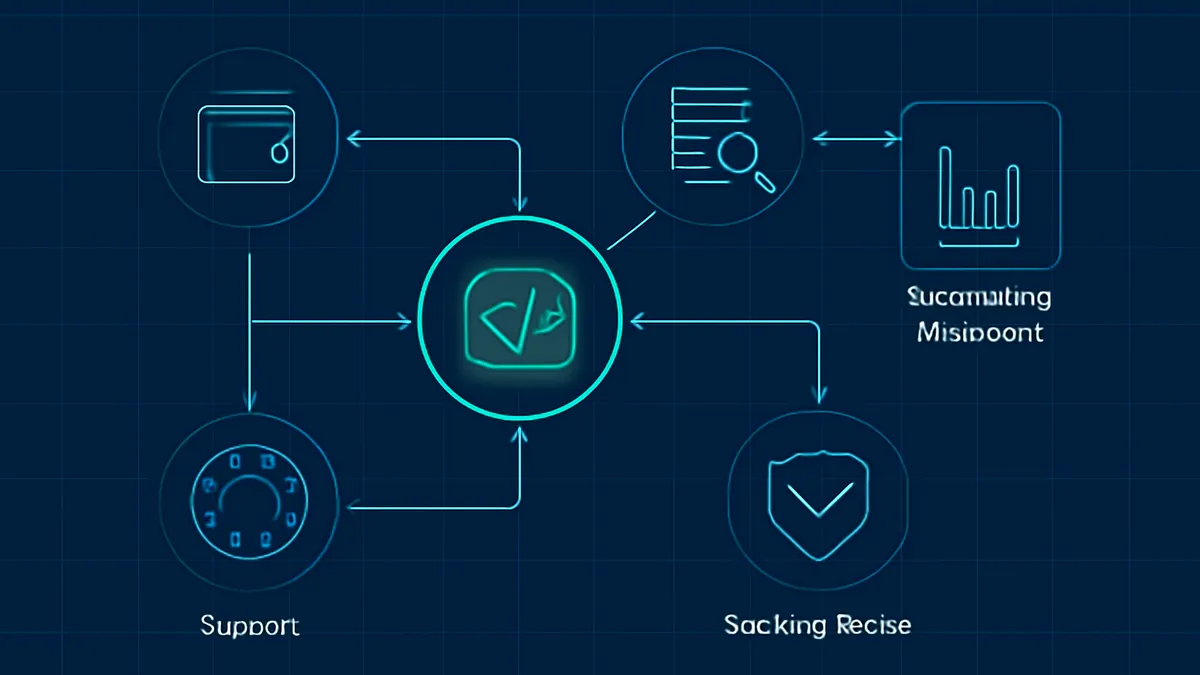
A Web3 feature rarely launches because a smart contract is merely finished. It launches when contract behavior, frontend flows, wallet compatibility, indexing, liquidity or settlement assumptions, monitoring, incident ownership, documentation, and support work together. A weakness in one layer can turn an apparently successful deployment into a stalled rollout, confusing user experience, or avoidable incident.
Dependency mapping makes those relationships explicit before a team spends limited engineering, review, and operational capacity. The goal is not to predict every failure. It is to identify the prerequisites that govern readiness, the work that can proceed in parallel, and the missing capability that would make expansion unsafe.
Why Web3 Features Fail at the Dependency Layer
Teams often organize work by component: contracts, frontend, infrastructure, growth, and operations. Users experience one transaction journey. They connect a wallet, review a signature, submit a transaction, wait for confirmation, and expect balances, positions, permissions, or receipts to update correctly. A release fails at the dependency layer when one component assumes another is ready when it is not.
A contract may be audited while the application presents an inaccurate allowance prompt. An indexer may ingest new events while its backfill strategy is incomplete. A liquidity-dependent feature may go live before the team has defined behavior during shallow liquidity, stale oracle updates, or congestion. These are not always coding defects; they are gaps between required operating conditions.
The official positioning of ANT RUSH—“Build. Explore. Conquer.”—can serve as a simple, low-stakes prompt for discussing sequencing and constrained choices. The comparison is limited to the general discipline of deciding what to build or expand first; it is not a claim about protocol security, token economics, market behavior, financial outcomes, or the game’s underlying mechanics.
Start by separating a dependency from a preference. A dependency is a condition without which a feature cannot safely or correctly serve intended users. A preference improves polish, conversion, or convenience without invalidating the core flow. This keeps every desirable task from being labeled launch-critical.
- Hard dependencies: deployed and verified contracts, required permissions, correct ABI integration, event availability, and a tested transaction path.
- Operational dependencies: alerts, dashboards, runbooks, on-call ownership, provider capacity, and support escalation.
- Ecosystem dependencies: oracle liveness, bridge availability, supported wallets, relayer capacity, or liquidity where the design requires it.
- Trust dependencies: security review, clear disclosures, user warnings, and documented administrative controls.
Do not mark a dependency complete because a vendor, testnet, or internal demo worked once. Record the expected condition, accountable owner, readiness evidence, and consequence of absence. That turns vague confidence into an observable release criterion.
Map the Critical Path Before Committing Engineering Resources
Build the map around a user outcome rather than a repository structure. Write a representative flow: “A new user connects a supported wallet, understands the requested action, submits a transaction, receives confirmation, and sees the correct updated state.” Then map every system and decision required at each step. Repeat for existing users, failed transactions, delayed indexing, and privileged operations.
For each node, capture four fields: prerequisite, owner, evidence of readiness, and fallback. Evidence must be concrete. “Indexer ready” becomes “the new event schema is indexed from a known block, backfill reconciles with chain data, and a dashboard exposes lag.” “Wallet support ready” becomes “supported wallet and chain combinations passed end-to-end tests, including rejection and network switching.”
Draw arrows only where work truly depends on earlier work. A frontend can often integrate against a stable interface while another team prepares monitoring. Production promotion, however, may depend on deployed bytecode, verified configuration, review gates, and a decision about who can pause or modify the system. The longest non-parallelizable chain is the critical path; prioritize it because extra effort elsewhere will not shorten the launch date.
Security belongs in this map, not in a final checklist. The NIST Special Publication 800-218: Secure Software Development Framework (SSDF), Version 1.1 provides a useful model for ongoing secure-development practices: protect the environment, produce well-secured software, respond to vulnerabilities, and control changes. For a launch, that means knowing which configuration changes alter risk, who approves them, how artifacts are traced, and how remediation reaches production.
A compact readiness statement avoids late confusion: “Proceed only when contract version X, indexer schema Y, wallet-flow tests Z, alert set A, support article B, and rollback procedure C are complete.” Use measurable thresholds where they are meaningful, but do not invent precision. A named decision owner is often more useful than a fragile score.
Find the constraint, not the busiest team
The apparent bottleneck is often the team with the longest task board. The real bottleneck is the limiting resource preventing the next safe step: a reviewer who understands the upgrade path, realistic test liquidity, an RPC quota, time to test mobile wallets, or an operations engineer needed for alerts and a drill.
For each scarce resource, ask: What cannot start without it? What downstream work is blocked if it slips? Can another person, tool, environment, or narrower scope substitute? If the answers are many, many, and no, protect that capacity rather than assigning its owner to visible but non-critical work.
Use Bottleneck Drills to Test Expansion Decisions
A dependency map is a hypothesis. A bottleneck drill tests it under controlled conditions before users bear the cost. Choose a credible disturbance, state expected behavior, and run the relevant flow locally, on testnet, in staging, or in a limited production rehearsal when appropriate. The purpose is not a perfect mainnet simulation; it is discovering hidden assumptions and delayed decisions.
Combine technical and operational constraints. Simulate delayed indexing and confirm that the interface shows pending state rather than an incorrect balance. Disable a nonessential provider and verify which screens degrade safely. Rehearse a revert caused by an expected user error. Test support handling when a user signs on the wrong network. For upgradeable systems, practice the exact approval, deployment, verification, and post-deployment validation sequence with production-like roles.
Ethereum’s guidance on Testing smart contracts supports layered testing: exercise logic thoroughly, use local and public test environments, and test integrations rather than treating deployment as the first real trial. Apply that approach beyond Solidity. The launch path includes RPC behavior, signatures, event consumers, caching, analytics, transaction replacement, and the messages users see when something fails.
Run a “two upgrades, one team” exercise when time is constrained. Put one change on the critical path and another in the useful-but-not-required category. Decide in advance which evidence would justify delaying the second change. The right result may be a smaller release with a clear boundary, not a broad launch with untested interactions.
After each drill, document the first point where the team lacked information, authority, or capacity to continue safely. That point may matter more than the simulated failure. If nobody knows who can pause a flow, the problem is ownership. If the team cannot distinguish missing from delayed events, it is observability. If a contract issue has no practical response path, it is release design.
Keep Rollback Capacity, Monitoring, and Support in the Launch Plan
Rollback is not always a literal reversal. Immutable contracts may not be reversible, and state transitions may already be final. Define a spectrum of response options: stop a frontend entry point, pause a contract function where appropriate, disable a relayer route, lower a limit, switch a read path, communicate a known issue, or guide users through recovery. The safest response depends on architecture and governance.
Map every response to its prerequisites. A pause mechanism is useless if the authorized signer is unavailable or the procedure is untested. A fallback RPC endpoint does not help if rate limits, chain coverage, and alerting were never validated. For every launch-critical dependency, ask: What can we stop, what can we observe, and who decides?
Monitor user outcomes as well as infrastructure health. Track submission and confirmation rates, revert categories, wallet and chain distribution, RPC errors, indexer lag, event-processing gaps, balance mismatches, and support volume by issue type. Establish a baseline where possible. An alert without an owner and action threshold is only a notification.
Support is a dependency, not post-launch cleanup. Prepare short explanations for rejected signatures, wrong-network errors, pending transactions, unavailable routes, and known limits. Give support staff a safe escalation path that never asks users for seed phrases or private keys. User reports can expose an integration bottleneck before an uptime chart does.
The launch decision should include stop conditions, such as unexplained balance discrepancies, a material rise in unexpected reverts, missing critical events, an unreviewed configuration change, or loss of monitoring for a safety-relevant dependency. These conditions establish the discipline needed to limit exposure while facts are gathered.
What Colony-Management Simulations Can—and Cannot—Teach Web3 Teams
Colony-management simulations can be a lightweight setting for systems thinking. Players allocate scarce resources among growth, gathering, exploration, and development, then see how an early choice constrains later options. A short exercise can prompt useful discussion: Which upgrade unlocks several later actions? Which activity drains a resource faster than it replenishes? When does expansion create more obligations than the system can support?
For a facilitated discussion, ANT RUSH’s About page supplies the project’s own concise framing: “Build. Explore. Conquer.” That wording is useful as a starting prompt for asking how building, exploration, and expansion can compete for limited capacity in an abstract planning exercise. Participants can explain why they delayed an upgrade, protected a resource, or changed plans after finding a constraint. The value is the discussion, not importing game rules into engineering.
The analogy has firm limits. A game cannot validate smart-contract correctness, threat models, key management, audit quality, governance controls, liquidity resilience, legal obligations, or user protection. It cannot estimate production-incident likelihood or impact. Real Web3 dependencies can involve adversarial behavior, irreversible state, third-party infrastructure, and incomplete information.
Use simulations only to rehearse a habit: state assumptions, identify the constraint, choose a sequence, observe the result, and revise the plan. Then return to the real launch map and require production evidence through tests, reviews, monitoring, and accountable approvals. Growth is safe only when the dependencies that sustain it are ready too.