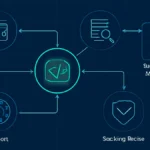



Blockchain technology explains how digital assets can be transferred, recorded and verified without relying on a conventional bank ledger. Yet most users do not live entirely inside a blockchain economy. Salaries, invoices, cards, business accounts and merchant settlements still operate largely through traditional financial systems. The practical challenge is therefore connecting these two environments. Infrastructure such as https://montvector.ch/ illustrates one model for bringing fiat operations, payments and digital asset transactions together through integrated banking, payment, liquidity and compliance providers.
This connection is useful to understand because a blockchain solves only part of the financial process. It can determine how a token moves between addresses, but it does not automatically provide a bank account, convert euros into crypto, process a Visa payment or settle the proceeds of an online sale. Those functions belong to a surrounding infrastructure layer. For readers interested in blockchain architecture and digital finance, studying that layer helps explain how decentralized technology interacts with everyday economic activity.
A blockchain transfer is not the same as a payment workflow
A native blockchain transaction may involve only a sender, a recipient address, cryptographic authorization and the network that validates the transfer. The process is governed by protocol rules and recorded on a distributed ledger. A payment made from a bank account or card follows a different path involving regulated financial institutions and payment networks.
When a user wants to buy a digital asset with conventional money, these systems have to meet somewhere. A bank or electronic money provider can receive the fiat funds, a payment processor can handle a card transaction, and a liquidity provider can execute the conversion into a digital asset. The user may see a single interface even though several organizations participate behind it.
This distinction also explains why transaction speed cannot be judged from blockchain confirmation time alone. An on-chain transfer might settle quickly while a preceding bank payment or subsequent fiat withdrawal requires additional processing. The entire user experience is determined by the slowest and most restrictive stage of the complete financial route.
Fiat on-ramps are gateways rather than blockchains
An on-ramp allows conventional money to enter the digital asset ecosystem. A user might begin with euros, dollars, pounds or Swiss francs and receive cryptocurrency after a bank transfer, card payment or other supported method. The conversion itself can be performed through an exchange or integrated liquidity provider.
The cost should be evaluated as a complete transaction rather than as one advertised commission. A user may pay a payment-processing fee, foreign-exchange cost, spread and blockchain withdrawal fee. If the service displays only the trading charge, the true amount lost between the initial fiat payment and the final crypto balance may be underestimated.
Transaction size also matters. A quoted price for a small purchase may not remain available for a substantially larger order. Liquidity depth, pricing methodology and the period for which a quote remains valid should therefore be part of the evaluation when meaningful sums are involved.
Off-ramps determine whether digital value becomes usable fiat
The opposite process is an off-ramp: converting a digital asset into conventional currency and moving the proceeds into a financial account. It deserves as much attention as the entry route. Buying cryptocurrency is only one side of the cycle; users should also understand how they can convert and withdraw it when necessary.
An off-ramp may have different limits, fees or verification procedures from an on-ramp. A service that allows an easy purchase does not necessarily provide identical conditions for a later sale. Settlement may depend on banking hours, payment partners, compliance review and supported withdrawal currencies.
A practical approach is to test the entire cycle with a modest amount. Deposit funds, complete the conversion, make any intended transfer, convert back to fiat and perform a withdrawal. This reveals the actual costs and processing stages before larger amounts depend on the same route.
MontVector shows how several financial layers can be combined
The infrastructure described by MontVector combines several functions that normally sit around a blockchain rather than inside it. The company presents multi-currency account infrastructure, fiat and digital asset exchange, payment cards, payment processing and merchant settlements through integrated third-party providers.
For private clients, the model includes infrastructure for multi-currency accounts, international payments, foreign-exchange operations, digital asset access and payment cards. For business clients, the focus extends to card processing, alternative payment methods and merchant settlement. This illustrates how blockchain-related services can become one part of a broader payments architecture rather than a standalone financial system.
Current status is important when evaluating the offering. MontVector states that its platform and compliance infrastructure are still under development and identifies 2026 as its launch target. It also says service availability depends on jurisdiction, onboarding approval and partner infrastructure. Any prospective user therefore needs to confirm which specific functions are actually available before relying on them operationally.
Why integrated providers still need to be understood separately
A single interface can create the impression that one company performs every financial operation. In reality, an integrated platform may coordinate a bank or EMI for accounts, an acquiring company for card payments, a liquidity provider for digital asset exchange and another provider for compliance or transaction monitoring.
This structure is not unusual in modern fintech, but users should understand it. The entity holding fiat funds may differ from the entity executing a crypto conversion. The card provider may operate under another regulatory framework, and payment-processing availability may depend on merchant category or jurisdiction.
Mapping these responsibilities helps users identify counterparty risk. If one provider becomes unavailable, only part of the platform may be affected—or several functions may depend on the same underlying partner. Operational resilience cannot be assessed correctly without knowing these dependencies.
Multi-currency accounts connect global commerce with digital assets
Cross-border digital businesses often work with several currencies before cryptocurrency enters the picture. A merchant may collect euros, pay a supplier in dollars and maintain another balance in pounds. Multi-currency account infrastructure can reduce unnecessary conversions and provide greater control over when foreign exchange takes place.
Once digital assets are added, performance measurement becomes more complicated. Suppose an investor converts euros into dollars and then buys a cryptoasset quoted in dollars. The eventual result may reflect both the change in the cryptoasset and movement in the EUR/USD exchange rate. Treating the entire gain or loss as crypto performance would blur two separate economic effects.
Accurate transaction records should therefore preserve the source currency, conversion rate, fees and value received at each stage. The same principle applies to a business receiving settlement in a currency different from the original customer payment.
Liquidity is the hidden engine of fiat-crypto conversion
When a user converts one asset into another, the transaction needs liquidity. That may come from an exchange, market maker or specialist provider integrated into the platform. The quality of this liquidity affects the spread and the size of transaction that can be completed without significant price movement.
For small transactions, the difference between a reference price and an executable price can be minimal. At larger sizes, the available market depth becomes increasingly relevant. A useful comparison therefore looks at the net amount received rather than only at the advertised exchange rate.
The Bank for International Settlements examines the evolving relationship between traditional money, digital assets and payment technology in its work on the next-generation monetary and financial system. One important theme is that technological innovation changes financial architecture, but trust, settlement and reliable monetary foundations remain central to functional payment systems.
Cards demonstrate how crypto can interact with existing payment rails
Payment cards are a good example of the boundary between digital assets and conventional finance. A user may manage funds through a digital platform, but a purchase at an ordinary merchant can still be authorized and settled through familiar card infrastructure.
The customer experience may look seamless even though several operations occur behind the interface. The platform checks the available balance, the card network processes authorization, a regulated provider supports the card infrastructure and settlement ultimately reaches the merchant through existing payment rails.
If digital assets are involved in the account structure, a conversion may occur somewhere in this sequence. That does not mean the merchant receives cryptocurrency. The distinction matters because direct blockchain payments and card purchases have different rules regarding finality, refunds, disputes and settlement.
Payment processing brings blockchain infrastructure into commerce
Online businesses generally want customers to pay through familiar methods. Card processing and alternative payment methods therefore remain relevant even if the company also works with digital assets. An integrated infrastructure can connect customer payments with merchant settlement and, where appropriate, digital asset transaction flows.
A useful system should preserve the relationship between the original sale and the final settlement. The merchant needs to know the gross payment, fees, currency conversion and net amount received. If each provider uses a different transaction identifier, reconciliation can become a significant administrative task.
This is where integration provides practical value. The purpose is not simply to offer more payment methods but to make the entire flow traceable. A technically sophisticated payment route is less useful if finance teams cannot reconstruct what happened to each transaction.
Blockchain settlement and merchant settlement should not be confused
Blockchain settlement refers to the confirmation and finalization of a transaction according to the rules of a distributed network. Merchant settlement usually refers to the process through which an acquiring or payment provider transfers funds owed to a business.
These concepts can intersect without becoming identical. A digital asset transaction may settle on-chain before a merchant receives fiat funds. Alternatively, a customer may use a conventional card while the merchant’s broader treasury infrastructure includes digital assets elsewhere.
Understanding this difference prevents a common misconception: that using blockchain-related financial infrastructure means every payment becomes an on-chain transaction. In practice, hybrid systems can use blockchain for some stages and traditional payment networks for others.
Compliance becomes part of the technical architecture
One of the largest differences between a permissionless blockchain protocol and a regulated financial service is the role of customer and transaction verification. A blockchain can process a valid cryptographic transaction without knowing the legal identity behind an address. Providers connecting fiat money to digital assets often operate under rules that require a different level of information.
MontVector describes AML, KYC and KYT processes as part of its developing infrastructure. KYC relates to customer identification, while transaction monitoring and KYT processes focus more closely on activity and potential risk indicators. Blockchain analytics can be integrated to support this review when digital asset transfers are involved.
The Financial Action Task Force provides international guidance on virtual assets and related financial crime risks. FATF standards call for risk-based controls for relevant virtual asset activities and service providers, including registration or licensing frameworks and AML/CFT measures implemented by jurisdictions.
Why a transaction may be valid on-chain but delayed financially
A blockchain network decides whether a transaction satisfies protocol conditions. A financial provider has additional obligations and policies. As a result, an on-chain transfer can be technically valid while a subsequent fiat operation is delayed for further review.
This distinction is particularly important for users moving larger amounts. A provider may request information regarding source of funds, business activity or the economic purpose of a transaction. These checks can occur after initial onboarding if later activity differs from the customer’s expected profile.
Users should therefore avoid treating a crypto balance as identical to instantly available bank liquidity. The time required for conversion, review and fiat settlement should be considered when funds may be needed for short-term obligations.
Cross-border payments make infrastructure design more demanding
Blockchain networks are accessible across borders, but fiat payment services remain jurisdiction-dependent. A provider may support one payment method in one country and a different set of services elsewhere. Merchant categories can also influence which acquiring or alternative payment methods are available.
The result is a hybrid environment in which the digital asset layer may be global while the fiat layer remains fragmented. Businesses need to understand supported currencies, permitted jurisdictions, settlement options and the providers responsible for each market.
MontVector explicitly notes that service availability depends on jurisdiction and partner infrastructure. This is an important limitation to preserve when assessing any integrated solution: a feature listed at platform level should not automatically be assumed to be available to every customer.
APIs help turn financial services into infrastructure
A financial platform becomes more useful to a fintech or online business when its functions can connect directly with other software. APIs allow applications to request account data, monitor transactions, initiate supported operations or receive payment status without repeated manual work.
Automation also raises the cost of mistakes. If a user manually enters one incorrect payment, one transaction may be affected. An incorrect API integration can repeat a faulty instruction many times. Access permissions and transaction controls therefore become part of the security architecture.
Applications should receive only the permissions they require. A reporting tool does not need payment authority, and a payment application does not necessarily need permission to change administrative settings. High-value operations can also be subjected to separate approval even when routine processes are automated.
Reconciliation is where different financial systems meet
Hybrid payment infrastructure can generate records in several places: a merchant platform, payment processor, financial account, digital asset provider and blockchain explorer. If these records cannot be related to one another, understanding the complete transaction becomes difficult.
A strong reconciliation process preserves a common reference along with the original amount, currency, fees, conversion rate and settlement value. If a blockchain transfer forms part of the process, the corresponding transaction identifier can also be retained.
These records are valuable beyond accounting. They allow a business to compare payment methods, analyze conversion costs and locate delays. Operational data can therefore become a source of decisions about which providers and transaction routes are worth maintaining.
Security responsibilities change across each layer
A user interacting with blockchain and payment infrastructure may need to protect several different types of credentials. A bank or fintech account relies on account authentication. A self-custody wallet relies on private keys or a recovery phrase. An API integration relies on machine credentials and access permissions.
These credentials should not be treated interchangeably. A private key should never be provided simply because a payment platform needs identity verification. Conversely, knowing a wallet address does not provide access to the assets stored through that address.
A practical security model keeps each layer separate. Account access uses strong authentication, wallet recovery information remains offline and protected, while API credentials are restricted to the minimum necessary permissions.
How to evaluate an integrated fiat-crypto platform
- Current status: distinguish live services from infrastructure that is still being developed.
- Responsible entities: identify which providers handle accounts, cards, payments and digital asset exchange.
- Jurisdiction: confirm whether each required service is available in the relevant country.
- Fiat currencies: review supported balances, transfers and foreign-exchange options.
- Liquidity: understand how fiat-to-crypto prices are formed and whether transaction size affects execution.
- Costs: include payment fees, spreads, FX costs and withdrawal charges.
- Compliance: review onboarding requirements and possible ongoing transaction checks.
- Settlement: understand when funds become available after each type of transaction.
- Reporting: verify that transaction histories can be reconciled and exported.
- Resilience: determine what happens if a banking, payment or liquidity provider is unavailable.
A useful model for tracing one transaction
Consider a user who begins with euros and wants to obtain a digital asset. The route could be represented as bank account → fiat payment infrastructure → euro balance → liquidity provider → digital asset → personal wallet. Every arrow represents another operational stage.
The reverse route might be personal wallet → digital asset provider → liquidity provider → fiat balance → bank transfer. Looking at the process this way reveals where spreads can appear, where compliance review may occur and which organization is responsible at each point.
A merchant flow can be mapped in the same way: customer → card or alternative payment method → acquiring infrastructure → processing platform → currency conversion if required → merchant settlement. Blockchain components can be introduced where useful without assuming the entire route must become decentralized.
The most important distinction is protocol versus infrastructure
Blockchain protocols define how distributed digital assets operate. Financial infrastructure defines how users connect those assets with accounts, cards, businesses and traditional currencies. The two systems solve different problems, even when a modern application places them behind the same screen.
MontVector is relevant to this distinction because its model is built around integrating fiat operations, payment services and digital asset transaction flows rather than replacing conventional finance with a blockchain protocol. It shows how a financial application can coordinate several regulated and technical providers around digital assets.
For readers exploring blockchain technology, this provides a more complete understanding of the ecosystem. Knowing how consensus, wallets and cryptographic signatures work explains the decentralized layer. Knowing how on-ramps, off-ramps, liquidity, payment processing and compliance work explains how that layer connects to economic activity outside the blockchain.
The boundary between the two is likely to remain important as digital finance evolves. Some activities may move toward tokenized or blockchain-based infrastructure, while others continue to depend on established banking and payment systems. The practical challenge is interoperability: allowing value to move between them without losing visibility, control or accountability.
That is why learning about crypto should not stop at the protocol level. The route from a bank account to a digital asset—and back again—contains its own technologies, counterparties and risks. Understanding those elements gives users a clearer picture of what actually happens when blockchain becomes part of real-world finance.