


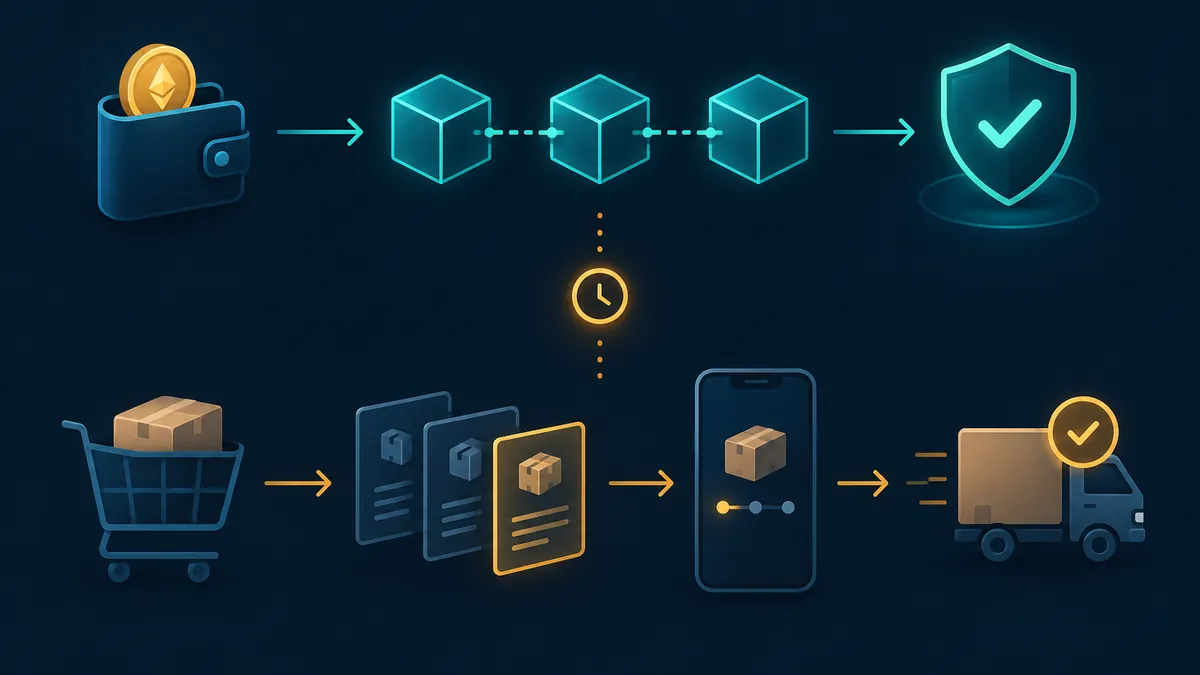
A wallet reports success, a transaction appears on-chain, and the checkout displays “Paid.” Has the customer received what they bought? Not necessarily. Blockchain settlement establishes facts about a payment; fulfillment depends on a separate system delivering a product or service. Confusing those events creates misleading receipts, duplicate orders and difficult refund decisions.
For Web3 builders, the challenge is coordinating systems that do not share one atomic transaction. A payment network, an order database and an external service provider can each succeed, fail or become temporarily unreachable independently. International mobile top-ups offer a useful example of this boundary, without requiring the service itself to use blockchain technology.
Payment confirmed, service still pending: the mobile top-up example
A mobile top-up starts with a destination and a recipient number, not a blockchain address. Someone sending credit abroad can begin at https://www.numio-mobile.com/ by choosing a country and entering a mobile number. Numio identifies the supported operator automatically, while available operators and amounts depend on the destination. This makes the purchase a concrete service request with details that must be checked before payment.
Those details matter independently of whether money moves successfully. A customer might enter the wrong number, select an unsuitable amount or misunderstand what will be delivered. Numio states that the final top-up amount depends on operator-supported denominations and may be rounded down to the nearest supported amount. A valid payment cannot correct an incorrect recipient or turn an unavailable denomination into an available one.
In a proposed crypto checkout, the equivalent lesson is to bind payment to a clear order specification: recipient, service, supported amount, price and expiry. Preserve the accepted version so later updates cannot silently change what the customer authorized. This is an architectural comparison, not a claim that Numio accepts cryptocurrency, exposes an API or integrates with wallets.
Model blockchain settlement and order fulfillment as separate states
A single “successful” flag hides too much. Maintain separate records for payment progress and delivery progress, then derive the customer-facing order status from both. Ethereum’s documentation on Proof-of-stake (PoS) explains checkpoint-based finality. Transaction execution, block inclusion and finalization are distinct concepts; none establishes that an external operator delivered a purchased service.
A proposed model might use the following states. These are design suggestions for a crypto-enabled system, not descriptions of Numio’s internal architecture:
- Payment: awaiting payment, observed, included, accepted under the settlement policy, failed or expired.
- Fulfillment: not requested, queued, submitted, confirmed, rejected or outcome unknown.
- Resolution: no action required, reconciliation pending, refund review, refund initiated or refund confirmed.
Define the evidence required for every transition. A transaction hash is a lookup reference, not proof of correct payment. Verify the network, asset or token contract, destination, amount and execution result. The policy for accepting settlement should reflect the chain and purchase risk. An observed transfer should not automatically authorize an irreversible delivery.
Likewise, distinguish a provider’s acknowledgment from its delivery confirmation. “Request received” may mean only that work has entered a queue. Store payment evidence and fulfillment evidence separately, with timestamps and correlation identifiers. This lets an incident responder determine whether the customer paid, whether delivery was requested and what supports the current status.
Prevent duplicate delivery when requests or notifications repeat
Retries are normal in distributed systems. A customer reloads the checkout, a worker restarts, or a notification arrives twice. The dangerous assumption is that each incoming event represents a new purchase. Instead, identify the business operation first, and make repeated attempts converge on the same result.
Stripe’s documentation on Idempotent requests illustrates how an idempotency key enables retrying a request after a connection error without duplicating the operation. It is a general implementation reference here, not evidence about Numio’s technology. Any integration must follow its own provider’s documented key scope, retention rules and retry behavior.
Within your application, assign a durable order identifier and a distinct identifier for each authorized fulfillment operation. Keep retries attached to that operation rather than creating a fresh delivery attempt whenever a timeout occurs. Enforce uniqueness in persistent storage, and ensure a payment cannot accidentally be assigned to multiple orders.
A reliable pattern is to commit the accepted payment transition and a fulfillment job in one database transaction. A worker then processes that durable job. If the worker crashes, it can resume without losing the intent to fulfill. This does not create universal “exactly once” delivery: an external provider may process a request before your system records its response.
That remaining gap needs an explicit policy. Use provider-side idempotency or status lookup where available. If neither can establish the outcome safely, move the order into reconciliation instead of blindly resubmitting. A lock prevents some concurrent work, but cannot tell you whether a remote service completed an earlier request.
Test delayed payments, operator rejection and ambiguous outcomes
A conventional lifecycle makes the payment-to-delivery boundary easy to see. How Numio mobile top-ups work describes country selection, number entry, amount selection and payment. After payment confirmation, Numio submits the top-up to the operator and displays transaction status. If the operator does not accept the top-up, the order is not completed and payment is handled under its refund policy. These are separate events, not one indivisible success.
For a crypto-enabled checkout, turn that distinction into fault-injection tests. Do not stop at checking whether the payment screen turns green. Test whether every component preserves the correct order state when information is delayed, repeated or missing.
- Payment arrives after expiry: confirm that a late transfer enters a defined review or acceptance path rather than triggering an outdated quote automatically.
- Observation precedes sufficient settlement: verify that an early chain event does not release fulfillment before the configured acceptance condition.
- Events repeat or arrive out of order: replay notifications and ensure they neither duplicate delivery nor overwrite a newer state with an older one.
- Provider rejects the request: retain the payment record, mark fulfillment as rejected and begin the appropriate resolution workflow.
- Submission times out: simulate remote acceptance followed by a lost response; require reconciliation before any potentially duplicate submission.
- Worker crashes after sending: restart processing and verify that the system investigates the existing operation rather than assuming nothing happened.
Write an invariant for each test. For example: one accepted order must not produce two successful fulfillment operations. Another is that a rejected delivery must not erase evidence of a received payment. Assertions about durable records are stronger than checking a transient interface message.
Design support and refund paths without promising reversibility
“Unknown” is a legitimate operational state, not a synonym for failure. If a provider response disappears, the service might already have been delivered. Automatically refunding and retrying can compound the loss. Reconcile using available status records, transaction references and provider evidence before deciding what action is safe.
Reversibility also differs across layers. A blockchain transfer generally has no card-style chargeback mechanism; returning funds usually requires a separate transaction. A delivered service may also be irreversible. Numio warns users to check the destination country, number and amount because submitted top-ups may not be reversible. Neither warning should be replaced by a blanket promise that every failed-looking checkout can be undone.
For a proposed crypto checkout, define refund authorization, destination verification, network selection, fees and approval requirements before launch. Track the refund separately from the original payment. “Refund approved,” “refund broadcast” and “refund confirmed” should not be interchangeable labels, especially when network congestion delays settlement.
Give customers precise language: “Payment received; delivery pending” is more useful than “Success” when only one stage is complete. Support staff need an order reference, relevant payment identifier, delivery status and event history. They should never need a seed phrase or private key. Restrict access to recipient phone numbers and other personal data rather than copying them into every diagnostic log.
A release checklist for reliable crypto checkout
Before release, trace one order from quote creation through settlement, fulfillment and possible refund. Identify which component is authoritative at each stage and which evidence justifies its decision. If the browser closes immediately after payment, background processing and reconciliation should still be able to resolve the order.
Exercise the recovery tools as well as the checkout. Can an operator investigate an uncertain outcome without resending the service? Can the system find paid orders that never entered the fulfillment queue? Can it detect duplicate notifications and delivery confirmations that arrived after a timeout? These checks reveal failures that a happy-path demonstration misses.
Monitor time spent between accepted payment and confirmed delivery, the size and age of the reconciliation queue, and rejected fulfillment attempts. Set escalation thresholds appropriate to the service rather than inventing a universal delivery deadline. Alerts should lead to a documented action, not merely report that something is pending.
The governing principle is simple: payment finality and fulfillment require different evidence. A dependable checkout makes that distinction visible in its data model, retry behavior and customer messages. Blockchain confirmation is an important milestone, but it is not a receipt for a service that another system has yet to deliver.